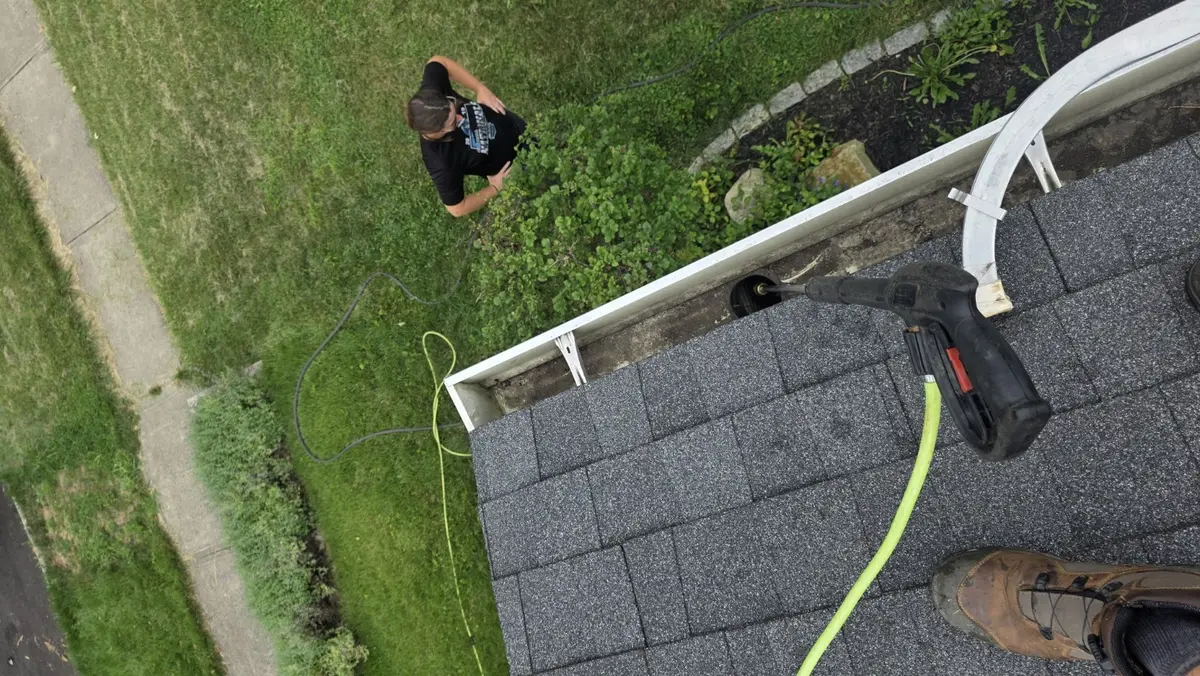
Your gutters overflow because water cannot reach an open exit fast enough. The usual causes are debris in the trough or outlet, a restricted downspout, lost pitch, loose support, concentrated water from a roof valley, material on a gutter guard, too little outlet capacity, or a buried drain line that is backing up.
Do not start by buying larger gutters. First, find where the overflow begins and follow the water toward its final discharge. A cleaning and flow test settles a surprising number of these cases without turning them into a replacement project.
If you are dealing with gutters overflowing in rain, the first goal is diagnosis, not drama. A clean-looking section at eye level tells you very little about the outlet, the elbows inside the downspout, or the underground connection below it.
CleanFlow’s professional gutter cleaning and flow testing follows that whole path where it is accessible. The gutter is only the first container in the system.
Start With Two Free Checks From the Ground
Watch Where the Water First Appears
Stand on the ground during steady rain and record a short video. Note whether the water crosses the front edge in the middle of a run, pours at a corner, shoots past the gutter below a roof valley, leaks behind the gutter, or rises near a downspout.
The first wet location matters more than the largest splash. Water travels after it escapes, which can make the bottom of the mess look like the beginning.
Check the Final Discharge Point
From the ground, see whether water leaves the bottom of the downspout, reaches a surface extension, or opens a pop-up emitter. A pop-up emitter is the small hinged outlet sometimes installed at the end of a buried line.
If water backs up where the downspout enters the ground while little or nothing appears at the outlet, the restriction may be below grade. That is no longer a routine gutter-cleaning diagnosis.
How Water Is Supposed to Move Through the System
Rain leaves the shingles and crosses the roof edge. The drip edge is the metal flashing that protects that edge; some homes also use gutter apron, a wider flashing detail that helps bridge water into the gutter. From there, the water enters the K-style gutter—the familiar residential trough with a shaped front face.
The trough carries water on a slight pitch toward an outlet. CleanFlow’s normal starting point is about 1/4 inch of fall per 10 feet. That is enough to move water without making the gutter look as though it was hung by someone leaning to one side.
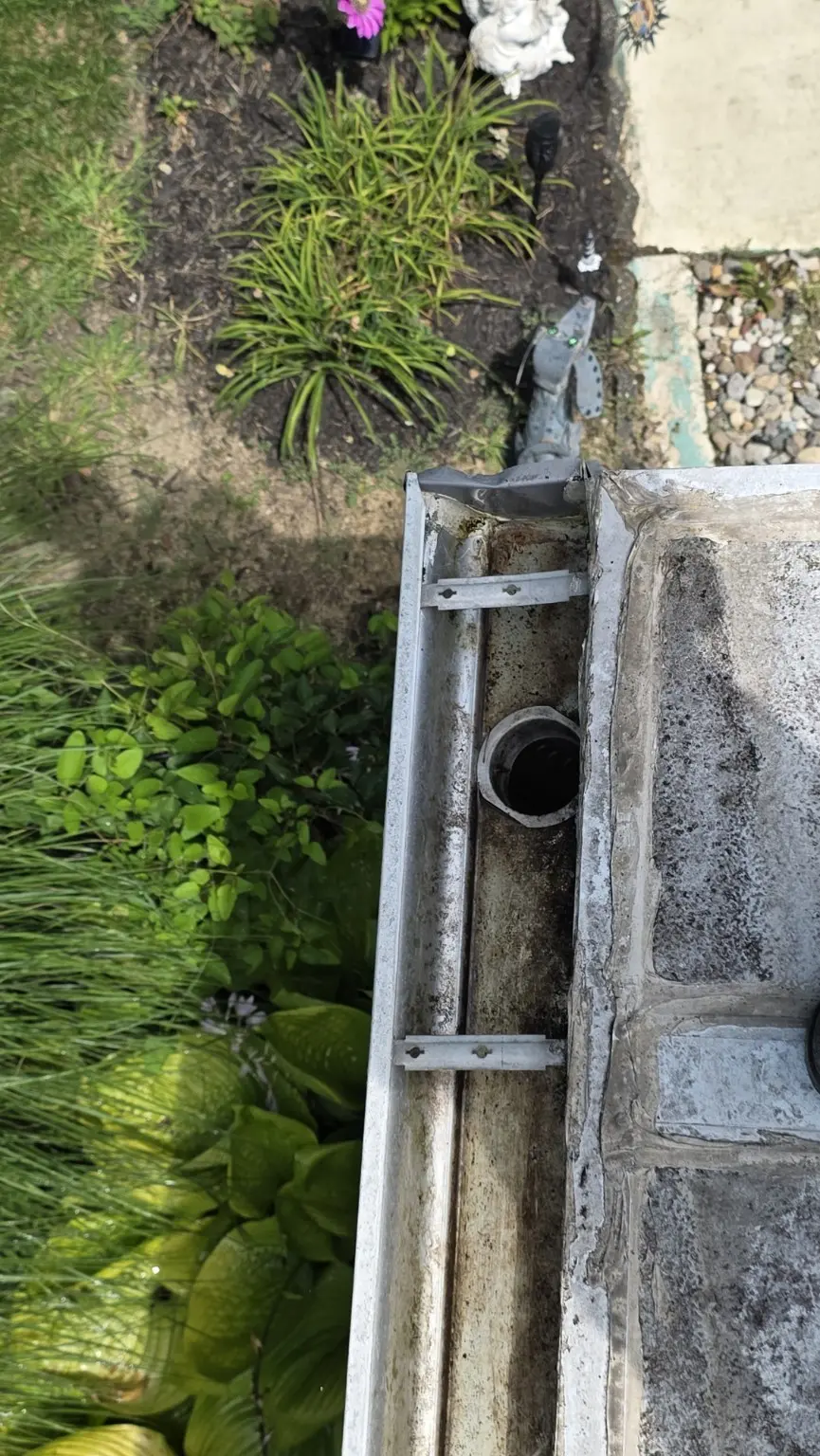
The outlet is the opening cut into the gutter. Water drops through it into a 2×3 or 3×4 downspout, passes through the elbows, and then discharges above ground or enters an underground drain line. Every part downstream must accept the same water the roof just delivered.
That is the mechanism. The overflow appears at the first place where the path loses the race.
The Most Common Reasons Gutters Overflow
Debris Is Blocking the Trough or Outlet
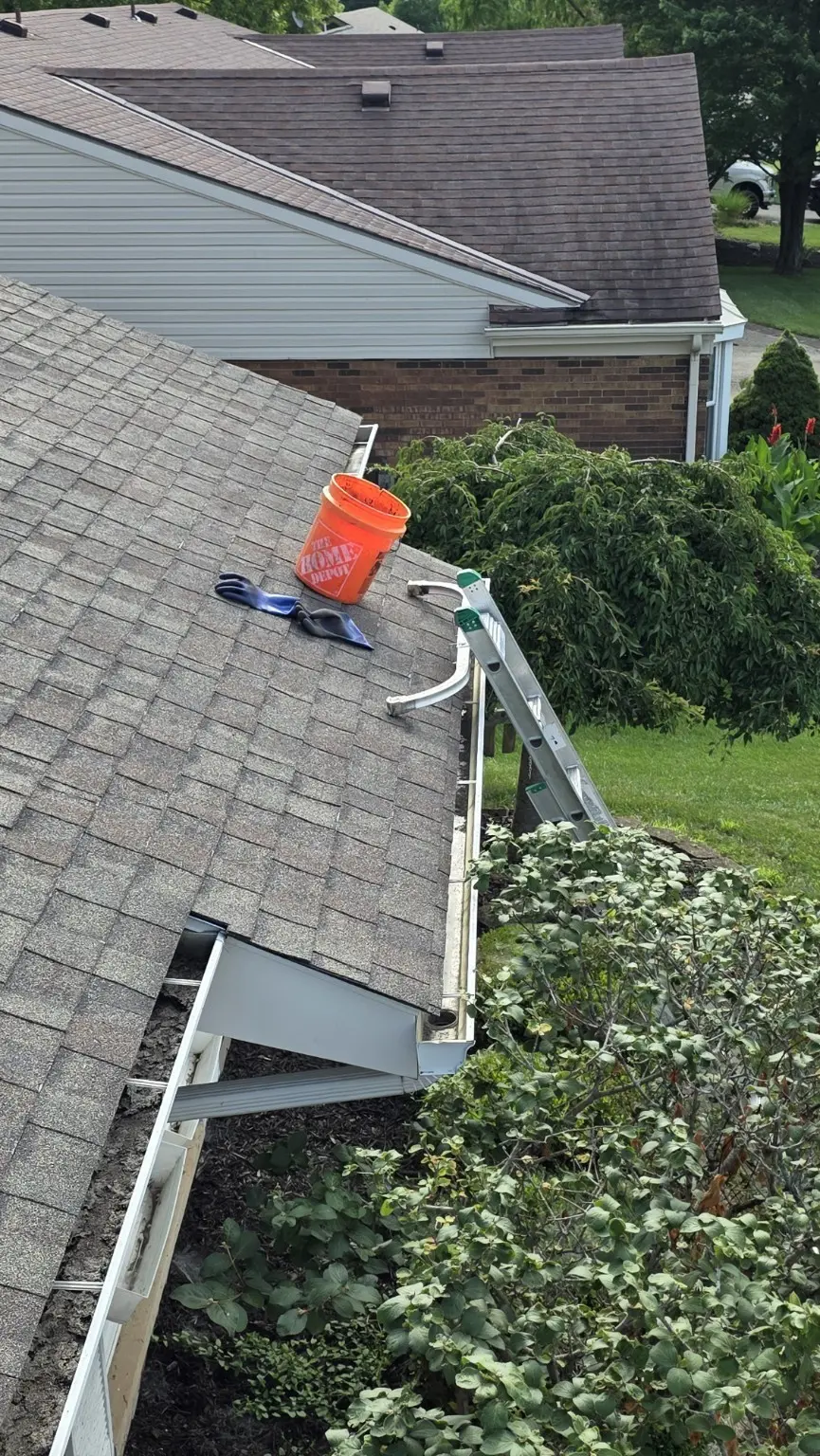
On Dayton-area homes, ordinary debris is still the cause CleanFlow finds most often. It is not always a visible pile of leaves. Maple seeds, small twigs, shingle grit, and decomposed leaves can settle into a heavy layer of muck, and a compact plug over the outlet can stop a long run while the rest of the trough looks fairly open.
Mature tree cover changes the schedule. Spring seed material, late-falling leaves, and roof grit arrive at different points in the year, so one calendar date does not fit every property.
The Downspout Is Restricted
The clog may sit in the outlet, the first elbow, the vertical downspout, or the lower elbow. Water then stacks upward. Once the outlet is submerged, the gutter behaves like a shallow tub with a plugged drain.
A 3×4 downspout gives water and debris a larger exit path than a 2×3, but size does not make a blocked pipe open. Clear the restriction before treating an upgrade as the cure.
I was once called out, and a client was convinced he needed six-inch gutters. He said his five-inch gutters couldn't handle the water volume coming off his roof. I was there to give him an estimate. But wouldn't you know, as soon as I got up on the ladder and gave the downspout a flow test, it was clear something was lodged in the downspout. It didn't take but a minute to take the elbow apart and find the golf ball surrounded by debris. After I got that golf ball out and flushed the downspout, the water flowed exactly as it should have.
The Gutter Has Lost Its Pitch
A sag or low section holds water away from the outlet. Debris settles there, wet material adds weight, and loose spikes or hangers let the low spot deepen. The gutter can overflow in the middle even with an open downspout.
The fascia is the board behind the gutter. If the gutter is pulling away from it, the problem may involve loose fasteners, weak wood, poor hanger placement, or several of those at once. CleanFlow’s normal new-system standard is hidden hangers at approximately 16 inches on center, with tighter support around corners and other high-stress areas; an existing system may be spaced very differently.
A Roof Valley Is Sending Water Too Fast
A roof valley is the inside angle where two roof planes meet. It concentrates runoff into a narrow part of the gutter, so water can overshoot or overwhelm that spot while the rest of the run behaves normally.
A splash guard can help where the roof geometry earns it. It is not a substitute for an open outlet, sensible downspout placement, or enough exit capacity.
Gutter Guards Need Service
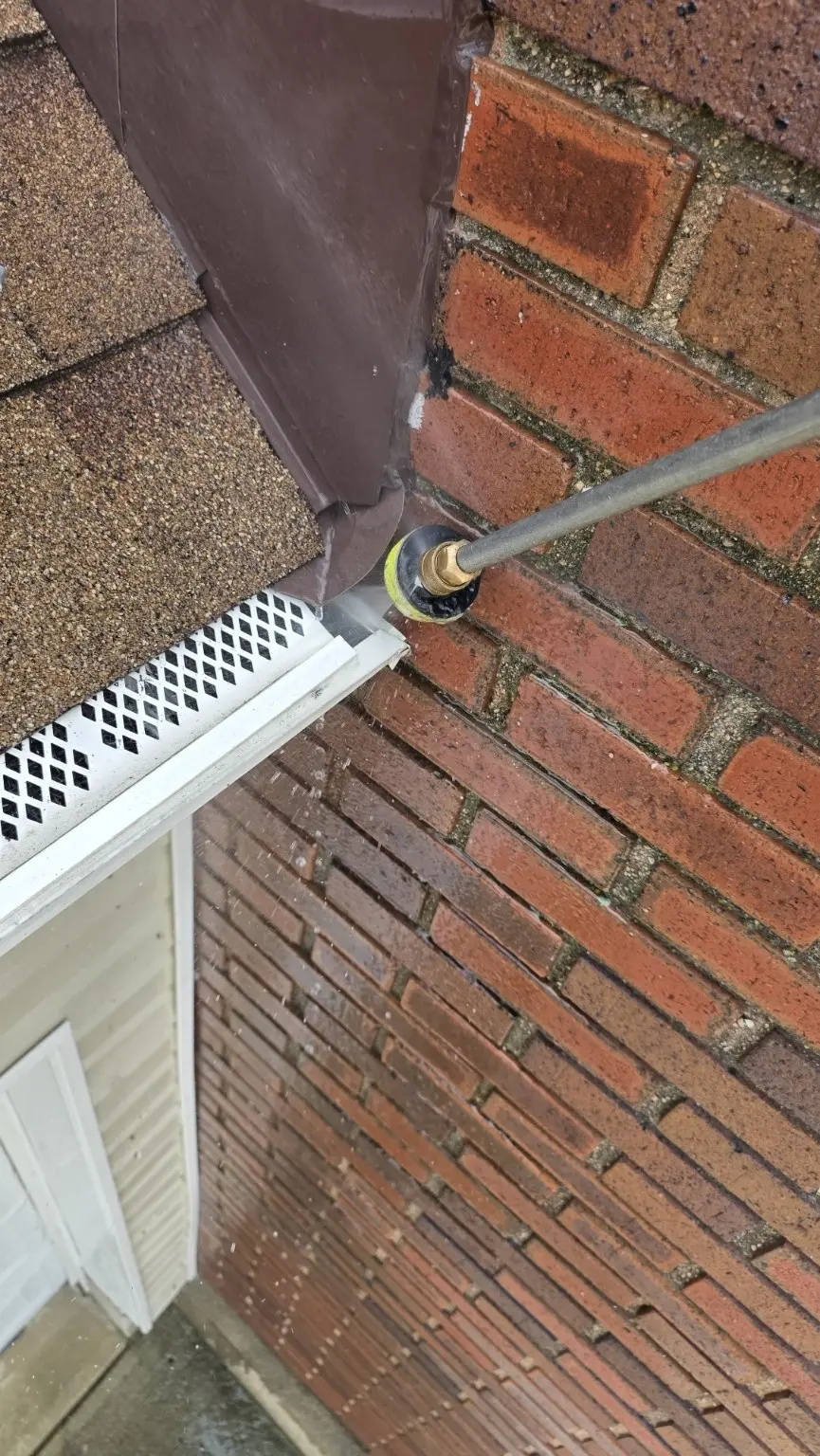
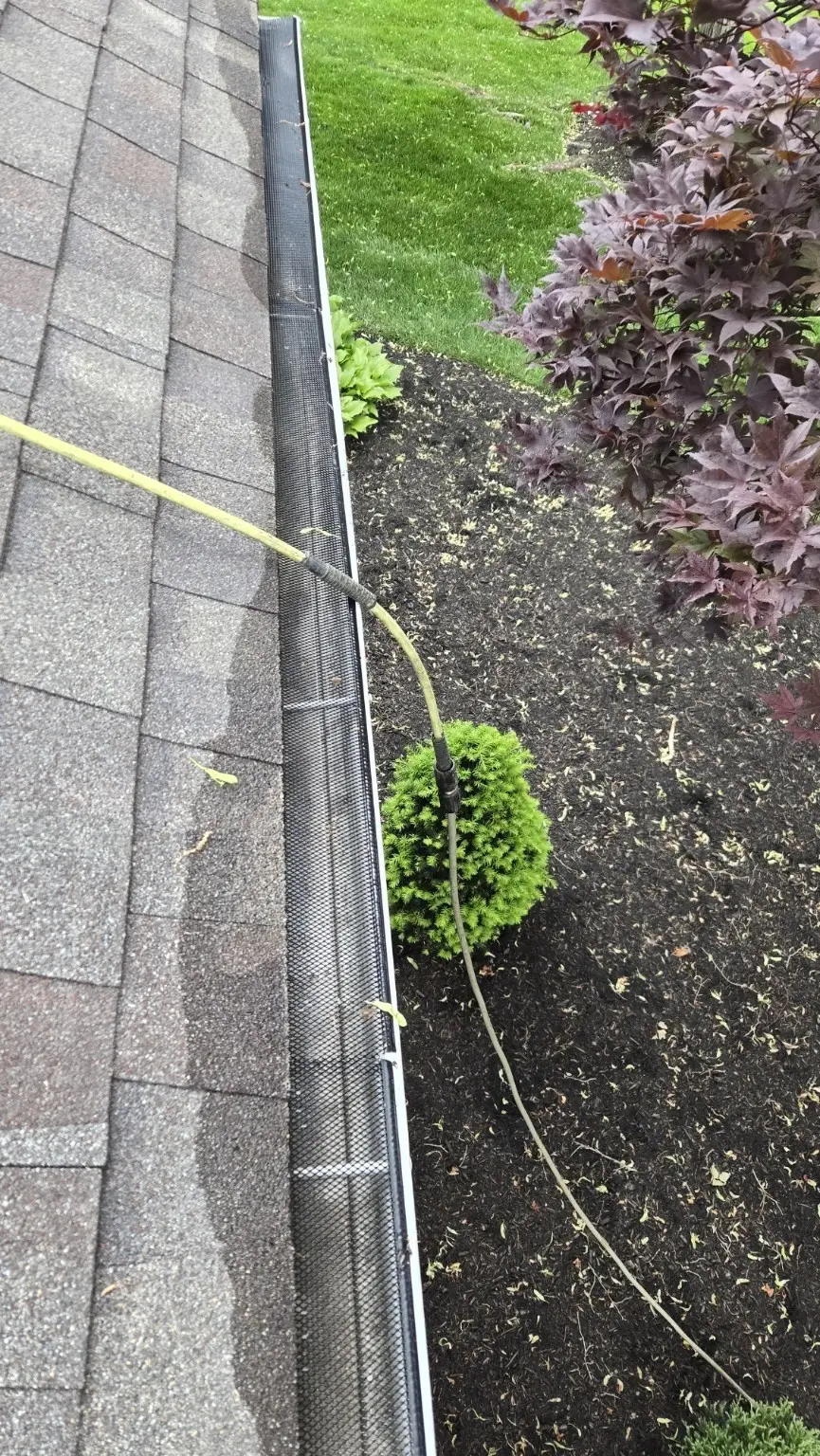
Gutter guards reduce certain debris problems. They do not repeal gravity. Fine material can settle on micro-mesh, leaves can bridge an opening, roof grit can collect beneath a cover, and valley water can run across the surface faster than it enters.
Start by identifying the guard type and the location of the overflow. Cleaning the top of a guard may solve one condition; removing and servicing the trough or outlet may be necessary for another. See the current gutter guard options if the existing protection is part of the problem.
The System Does Not Have Enough Exit Capacity
Some systems are genuinely short on capacity. A large roof area, steep pitch, several valleys, too few outlets, small downspouts, or an upper roof feeding a lower run can move more water into one section than it can discharge.
That does not make 6-inch gutters an automatic answer. A properly designed 5-inch K-style gutter with 2×3 downspouts can serve a straightforward roofline. CleanFlow pairs 6-inch gutters with 3×4 downspouts when the roof, valleys, outlet layout, and discharge path justify the larger system.
When the Gutter Looks Clear but Water Still Spills Over
The view from the lawn hides the working parts. You cannot see a compacted outlet, debris inside an elbow, water sitting in a low spot, or a buried line refusing the flow. A clean front edge proves that the front edge is clean.
Water spilling over gutters can also be water passing behind them. If runoff slips between the roof edge and the gutter, inspect the drip edge, gutter apron, gutter height, fascia condition, and roof-edge details. Cleaning will not correct missing flashing or a gutter hung too low to catch the water.
This is where calm diagnosis saves money. If the water is missing the trough, increasing the trough size does not move it under the stream.
When the Problem Is Below Ground
A downspout can be completely open and still back up at the underground connection. CleanFlow finds this on Dayton-area homes where downspouts feed older buried drainage systems. Roots, silt, crushed pipe, sharp buried turns, failed transitions, or an obstructed outlet can restrict the line after the gutter and downspout have done their jobs.
CleanFlow separates the two paths before blaming either one. If the downspout attaches to a buried line, the crew disconnects it at that transition and flushes the above-ground downspout. When necessary, the elbows or downspout sections come apart for inspection. The underground line is then tested on its own to confirm whether it accepts and moves water.
Gutter cleaning removes material from the gutter and clears the above-ground route. Repairing or replacing a failed buried line is underground downspout and yard drainage work. Keeping those scopes separate prevents a cleaning invoice from quietly becoming a trenching project.
What the Overflow Location Can Tell You
| What you see | Likely area to inspect first | What it does not prove |
|---|---|---|
| Overflow in the middle of a long run | Debris, a low spot, lost pitch, or too much roof area feeding that section | That the downspout needs replacement |
| Water stacks up beside the downspout | Outlet, upper elbow, vertical downspout, or buried connection | That the gutter itself is too small |
| Water shoots past the gutter below a valley | Valley concentration, gutter position, outlet capacity, or a justified splash guard | That the entire home needs 6-inch gutters |
| Water runs behind the gutter | Drip edge, gutter apron, gutter height, fascia, or roof-edge detail | That debris is the only problem |
| Water backs up where the downspout enters the ground | Underground drain line and final discharge | That another gutter cleaning will fix it |
| Water crosses the top of a gutter guard | Surface debris, guard condition, roof valley, openings, or outlet below the guard | That every guard on the home has failed |
Which Fix Matches Which Cause
Cleaning and Flow Testing
Remove the debris, clear the outlet, flush each downspout, and confirm where the water exits. This is the first move when the cause is unknown because it separates a blockage from a structural or capacity problem.
Repairing Pitch, Hangers, Fascia, or Roof-Edge Details
A low run may need to be re-pitched. Loose sections may need proper hangers and sound fastening into solid material. Soft fascia, inadequate drip edge, or a missing gutter-apron detail needs to be shown and addressed rather than hidden behind fresh hardware. See the site’s gutter repair details for the repair side of that work.
Adding Capacity or Replacing a Failing System
Larger K-style gutters, 3×4 downspouts, additional outlets, or another downspout can help when the roof load and layout support the change. Replacement also makes sense when the trough is badly worn, repeatedly losing pitch, or attached to a roof edge that needs to be rebuilt correctly.
A seamless gutter installation should be designed around the roof, fascia, valleys, outlets, downspouts, and final discharge. The gutter color is the pleasant part. The water path is the useful part.
Repairing the Underground Drainage Path
If the buried line cannot accept water, the fix belongs downstream. That may mean clearing an accessible restriction, correcting a failed transition, replacing damaged pipe, adding cleanout access, or redesigning the discharge around the property.
What You Can Safely Check Yourself
- Record where the overflow starts during rain from a safe spot on the ground.
- Look for a visibly sagging section or a gutter pulling away from the fascia.
- Check whether the lower downspout elbow or surface extension is crushed or disconnected.
- Watch the underground transition for water rising or spilling back out.
- Locate the pop-up emitter or other final outlet and see whether water reaches it.
- Photograph the roof valley, downspout location, and ground-level discharge so the whole route can be reviewed together.
Leave the wet-roof work alone
Do not climb onto a wet roof or set a ladder simply to confirm what your phone can document from the ground. If a hose test requires roof access, the free test has become professional work.
What Professional Diagnosis Should Include
I start at the exact spot where the gutter overflowed. I first determine whether water crossed the front, ran behind the gutter, collected in a low section, or poured over below a roof valley. That pattern points the inspection in the right direction before anything is taken apart.
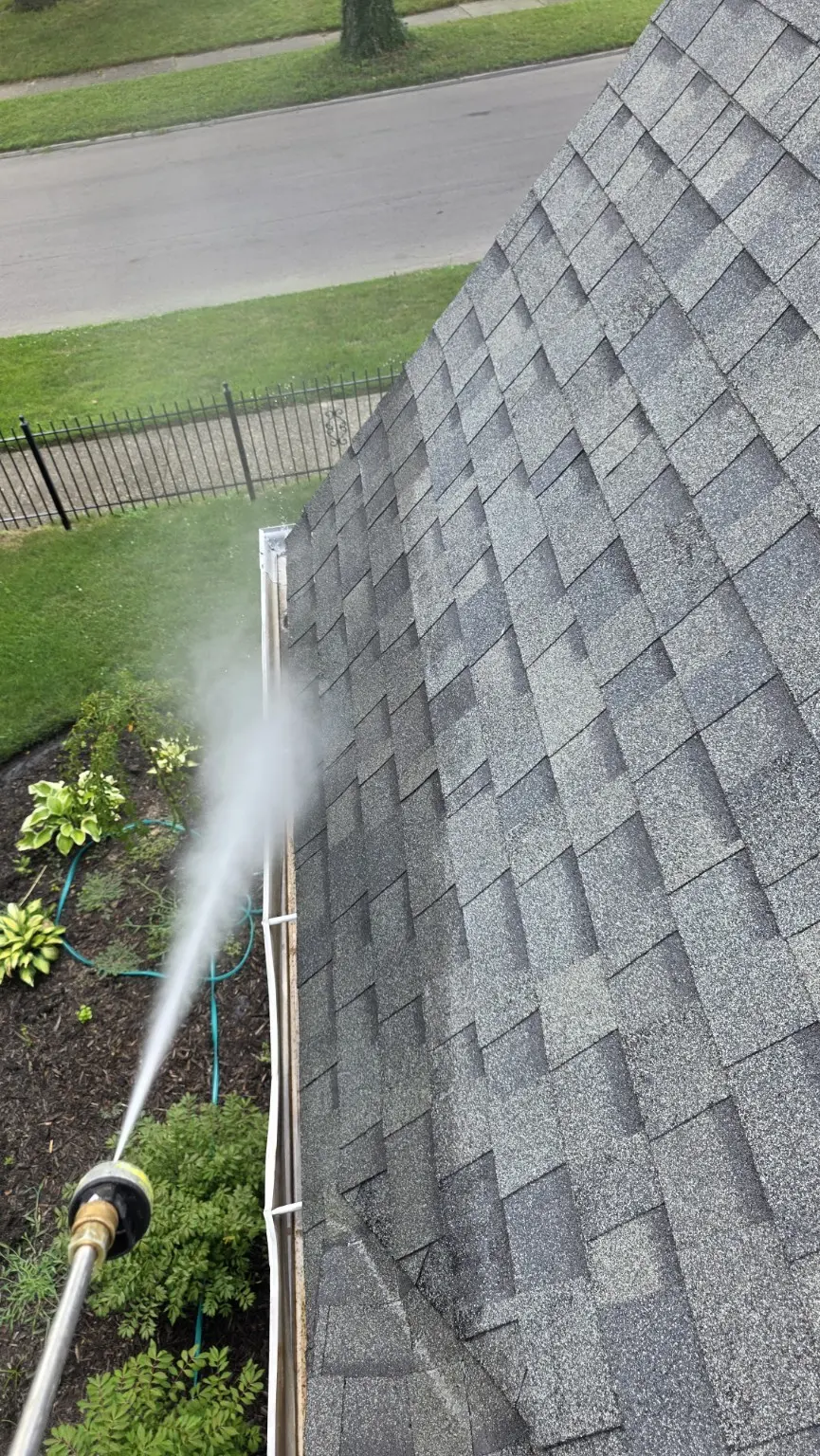
From there, CleanFlow clears the gutter and roof-valley debris, opens the outlet, flushes the downspout and elbows, and isolates any connected underground line. Pitch, alignment, hangers, and fascia come next. A low-looking section should not take the blame for an outlet packed with debris.
If the cleared system is properly supported and still overflows, the last check is roof design and water volume. A valley can concentrate a tremendous amount of runoff into one short section. At that point, the answer may be outlet placement, a 3×4 downspout, another downspout, or a justified splash guard—not a whole-house replacement.
The result should tell you where the problem stops. If cleaning restores flow, good. If the downspout runs but the buried line backs up, that is a separate finding. If water overshoots at a valley or passes behind the gutter, that belongs in the recommendation instead of being buried under “cleaned gutters.”
Overflowing Gutter Questions Dayton Homeowners Ask
Can gutters overflow even when they look clean?
Yes. The outlet, downspout elbows, vertical pipe, low spots, and underground connection are difficult to judge from the ground. Water testing shows more than a visual glance.
Do gutter guards stop overflow?
They can reduce recurring debris inside the trough, but they can still collect material on top, clog beneath the cover, or struggle where a roof valley concentrates water. The guard type and overflow location decide the service.
Do I need 6-inch gutters?
Not automatically. A clear, properly pitched 5-inch system with sensible outlet placement can serve many straightforward homes. Roof area, pitch, valleys, outlet count, downspout size, and the final discharge determine whether more capacity is useful.
Can an underground drain make the gutter overflow?
Yes. A restricted buried line can back water into an otherwise clear downspout. The clue is often water rising at the ground connection or failing to reach the known outlet during a controlled flow test.
Why does water spill behind the gutter?
Water behind the gutter can point to gutter position, loose attachment, damaged fascia, inadequate drip edge or gutter apron, or another roof-edge detail. That symptom deserves inspection before anyone promises that cleaning alone will solve it.
Does one overflow during hard rain mean I need replacement?
No. Record the location and see whether it repeats. A temporary debris bridge, a blocked outlet, or one concentrated valley may have a smaller answer. Replacement earns its place only after the system is clear and the remaining limitation is understood.
The Practical Next Step
Watch the next rain from the ground and note where the water first escapes. If the cause is still unclear, CleanFlow of Ohio can clean and flow-test the gutter system, document what is happening, and explain whether the correction belongs in the gutter, downspout, roof edge, or underground line.